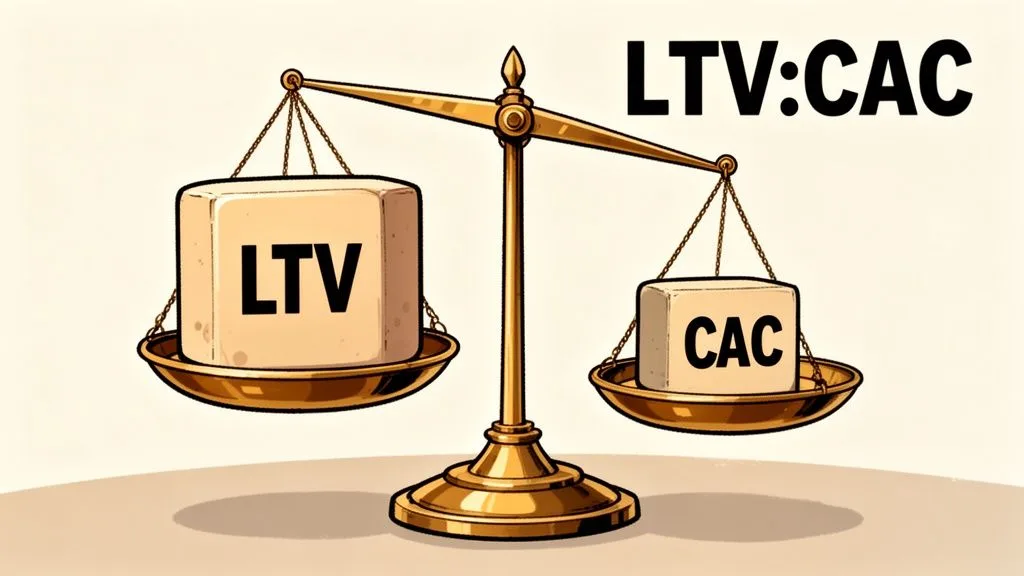
CAC and LTV: Key Metrics for Measuring Business Growth and Sustainability We may sometimes notice that businesses invest money in acquiring long-term customers, yet the amount spent does not generate satisfactory results or attract the expected number of customers. This highlights the importance of understanding two key metrics: the cost of acquiring a customer and the value that customer generates for the business.
Two important metrics for any business owner are CAC and LTV. These metrics help companies evaluate growth efficiency and measure the sustainability of their business growth.
CAC (Customer Acquisition Cost) measures the average amount a company spends to acquire each new customer, whether through marketing, sales, or any other method used to convert potential customers into actual customers.
On the other hand, LTV (Customer Lifetime Value) measures the total profit a company expects to generate from a customer throughout their relationship with the business. This metric helps determine the long-term economic value of each customer.
The importance of these two metrics lies in comparing the cost of acquiring a customer with the value that customer generates for the company. The higher the LTV compared to CAC, the greater the potential return on customer acquisition.
Christina Wallace, a professor at Harvard Business School, explains in her Entrepreneurial Marketing online course that a general rule of thumb is that an LTV-to-CAC ratio of 3:1 or higher is considered attractive and indicates a business model with strong potential for scalability. This suggests that a company can cover its customer acquisition costs and overhead expenses while still generating profit.
Conversely, if the LTV-to-CAC ratio falls below 1, it means that the cost of acquiring a customer exceeds the financial value that customer generates for the company. In other words, the business loses money with every new customer it acquires.
Practical Example:
If a company spends OMR 100 to acquire 20 customers, its Customer Acquisition Cost (CAC) is OMR 5 per customer. If each customer generates OMR 36 in profit throughout their relationship with the company, their Lifetime Value (LTV) is OMR 36.
This means that every OMR spent on customer acquisition generates an expected OMR 7.2 in profit, reflecting efficient customer acquisition spending and the ability to attract customers who generate sustainable returns.
Comments
Related articles
- Entrepreneurship
 18 July 20265 min70% of businesses close within less than 10 years of their founding
Studies indicate that approximately 70% of businesses close within ten years of their inception. For many major companies, the end came not from a lack of resources, but from the conviction that they had become too big to change. Ignoring technological shifts and failing to heed customer feedback or evolving trends turns yesterday’s success into a burden that prevents the business from achieving long-term sustainability.
NNoah Alzakwani - Entrepreneurship
 28 May 20265 minTrade and striving: The story of the companion Abd al-Rahman ibn Awf
Abd al-Rahman ibn Awf used to enter the market with very little money, but when he left it, Allah had blessed his trade and profit because of his intelligence in buying and selling and his good management in trade.
NNoah Alzakwani - Entrepreneurship
 28 May 20265 minThe Trade is the fastest way to get rich
Trade is the fastest way to wealth, but not everyone who masters a trade masters building a business. Trade is one of the fastest paths to wealth compared to a traditional job because the returns are unlimited, and often, the higher the risk, the greater the opportunities and profits.
NNoah Alzakwani